
Data sovereignty for climate markets.
Practical principles, tools, and practices for applying FPIC in the context of data and Indigenous data sovereignty (IDsov).
The rules below are incorporated into our contracts and policies and apply across every site we work with. We’ll outlink to training and practice materials as applicable.
Grower information
For all Savimbo growers
Year
2026
Data sovereignty principles
Enforceable
control > OPINIONS
There is no point in talking about data sovereignty and data rights unless agreements can be enforced under appropriate legal systems or by properly storing, attributing, and controlling access to data. Permissions that are too general, or too early, are also dangerous. Sometimes, air-gapping (not recording data at all) is the best practice given the current risks to communities of improperly controlled data accessed by AI. Control first, then negotiation.
Verticals
CONCRETE CASE STUDIES
The ethics of inaction do apply to data sovereignty. We cannot just wait either. Instead, we need to focus on concrete verticals which are properly biculturally negotiated from advanced data use (industrial world expertise) to grassroots authorities (Indigenous and traditional aims). These verticals might be narrow in scope to begin, but collectively will begin forming more comprehensive and useful standards as case studies. This early process is ethical if approached as experimental.
Interactive
CONSENT NEEDS EDUCATION
We can’t even begin forming proper consents until we have multimedia, multilingual, modular concepts broken down for communities to think over, redesign, and debate. Teaching pages like this one allow the debate to happen first, before decisions are made. Even then, the heterogeneity of thought and fast-paced nature of the problem will require constant renegotiation and open communication channels. Definitive consensus will require formal Participatory Action Research (PAR) study format.
Data sovereignty verticals
-
![Savimbo rat character art — community data ownership card]()
Ownership vs. licensing
We tell all communities to keep ownership and sell licenses. In other words, “rent; don’t sell your data”. The community owns all data collected on its territory, at every point in the chain. Ownership never transfers — clients are licensed to use data for specific purposes, never to own it. And never sell resale rights.
Owned by community · Never transferred · Use, not share · Consent to redistribute
-
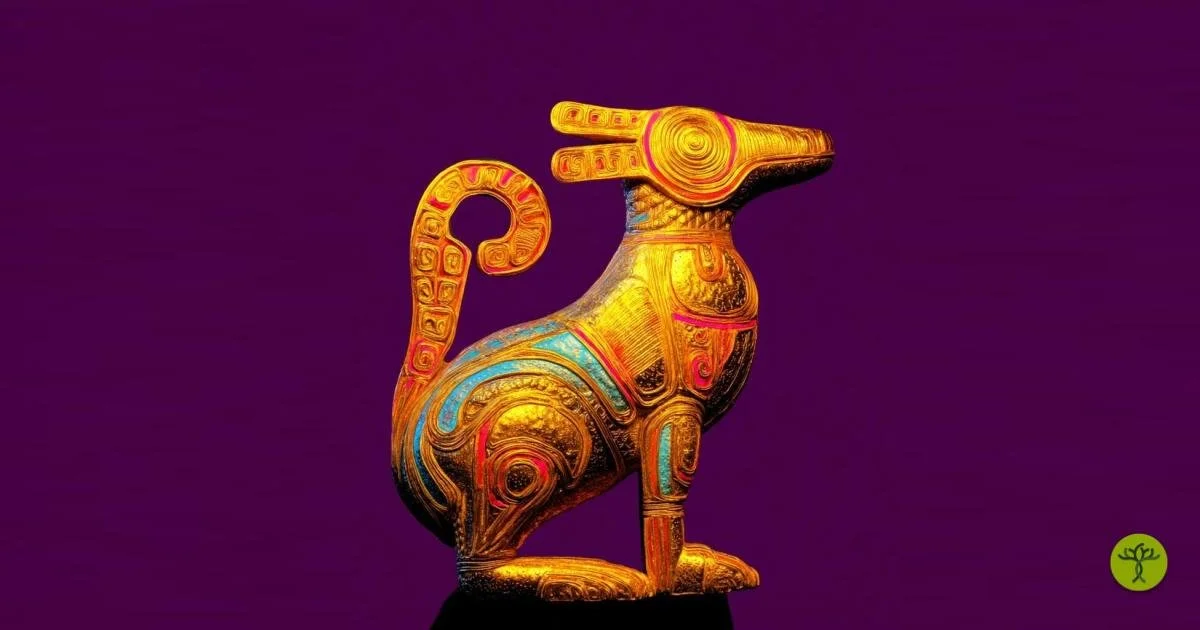
![Savimbo dog character art — air-gapping data practice card]()
Air-gapping
What you don't collect, you can't lose, misuse, or mistranslate. We strip all humans from camera footage before anything reaches the cloud, and store the minimum cultural and language data needed to establish authenticity — no medicinal or sacred-plant data, no geocodes.
Humans stripped pre-cloud · Minimum-collection rule · In practice now
-
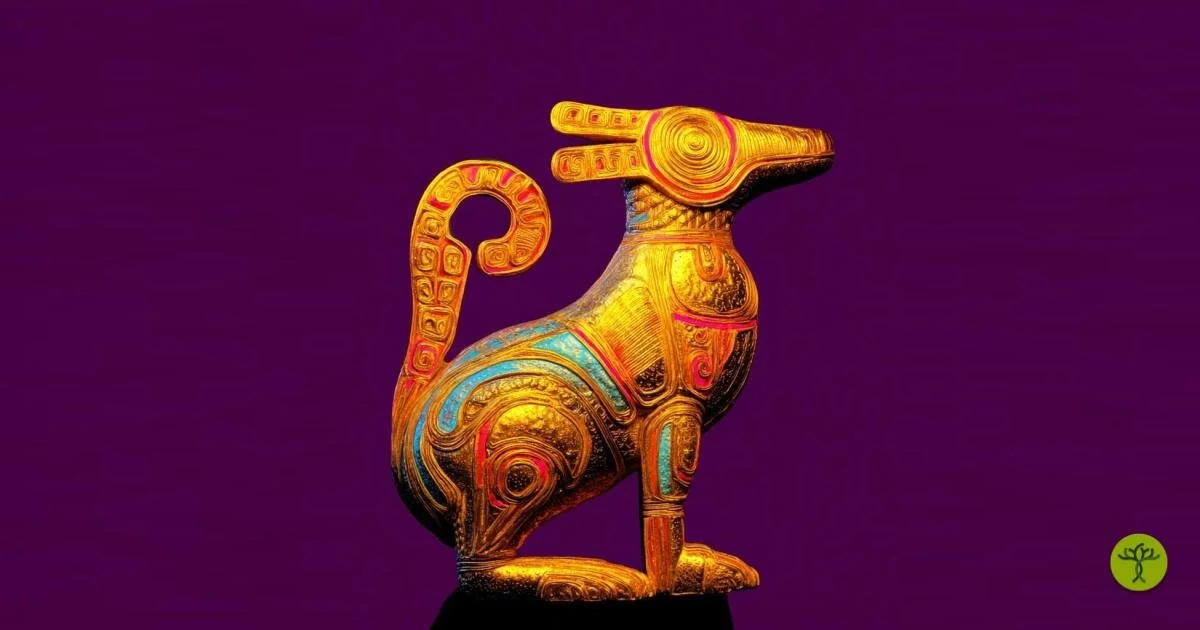
![Savimbo puma character art — data steward and concierge card]()
Data steward + concierge pairs
We pair community data stewards with community-partner data concierges. Together they manage community data and communicate to the collective about what is available, how to retrieve it, and present it in an accessible format.
Community-appointed · Reports to assembly · Client-provided · On the community's call · Every site
-
![Savimbo beetle character art — eDNA consent case study card]()
eDNA consent
Environmental DNA reads the genetic traces an ecosystem leaves in soil and water — and can incidentally capture human sequences. Before any analysis or publication, samples are screened for human DNA, which is filtered and permanently deleted; raw samples are destroyed after use, and the data steward is told when disposal happens.
Human sequences deleted · Steward-verified disposal · First negotiated case
-
![Brightly colored beaver thing]()
Savimbo beaver character art — plant knowledge referral card
Medicinal-plant and cultural knowledge stays off the ecological track — either not collected, or referred to external bodies with proper ethical protections like the Beneficial Plant Research Association. No bioprospecting, no biopiracy.
Air-gapped or referred · BPRA-protected · Every site
-
![Savimbo dragon character art — open-source data contracts card]()
Open-source contracts
Our data contracts are public and take ongoing community feedback. Legal team in the Ethics program. Practice-based incorporation of principles. License-not-transfer, written down and enforceable — proof we mean it about data rights, not just principles on a page.
License, never transfer · Public & revisable · Live
-
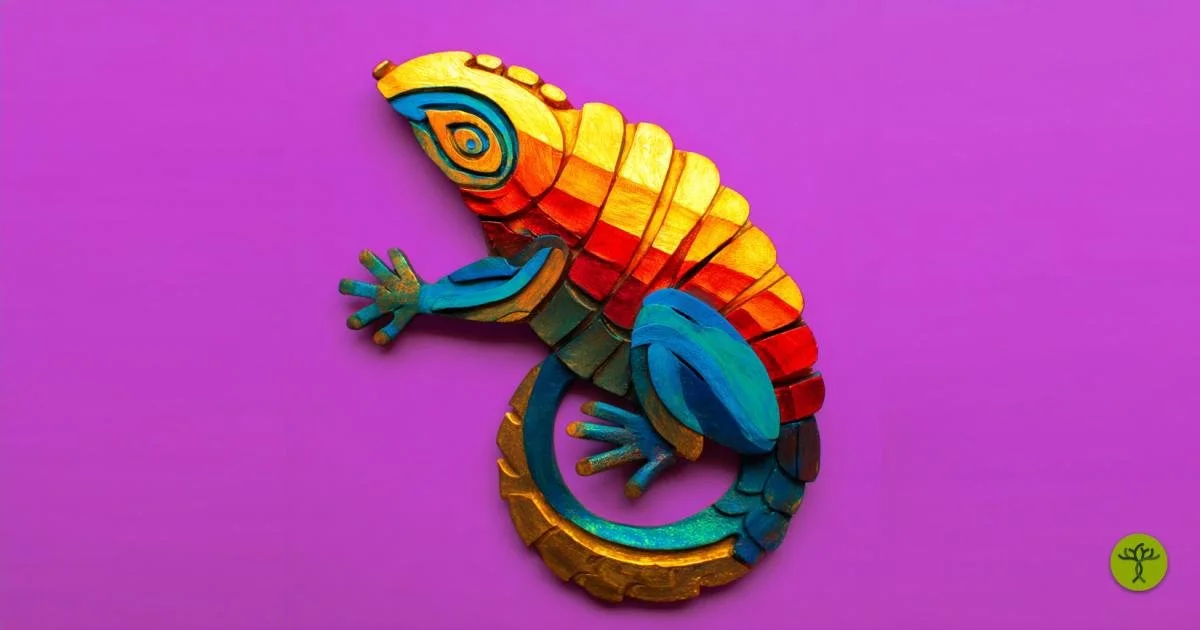
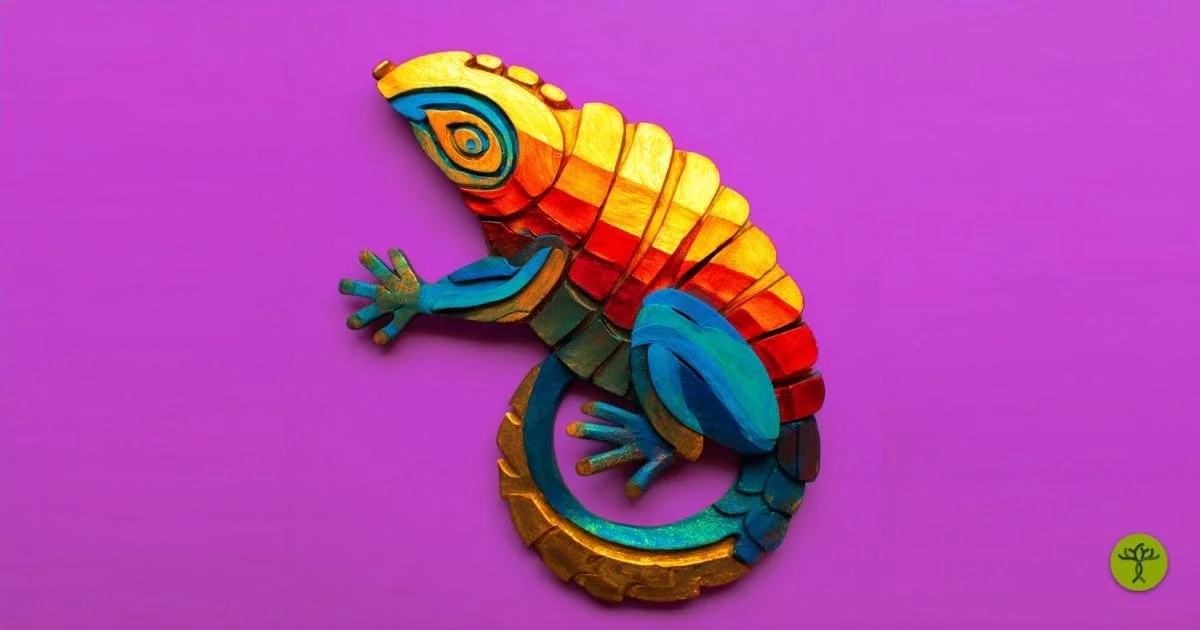
![Savimbo lizard character art — trade secrets strategy card]()
Trade secrets
We don't want your secrets. Medicinal plants, cultivation techniques, rituals, languages, rare-species locations — keep them. Savimbo rewards outcomes, not information, so your knowledge stays a trade secret: private, proprietary, and yours for generations. Patents and publications expose knowledge; silence protects it.
Reward outcomes, not data · Trade-secret model · Every site -
![Savimbo guara character art — Indigenous authorship credit card]()
Authorship credit
Academic work or other publications drawing on community data must credit the traditional groups or individual Indigenous trackers behind it — as authors or named contributors, never as anonymous informants.
Named, not anonymous · Author or contributor · Includes raw data
-
![Savimbo iguana character art — bicultural negotiator card]()
Bicultural negotiators
We still recommend communities use bicultural negotiating teams for discussing any transactions or contracts regarding their data, as the skillset of fair data transactions is very new, and concentrated in the industrial world.
Education first · Translational leadership · Cultural lawyers






DATA SOVEREIGNTY PRACTICESKeep ownership, sell licenses

We teach communities how to retain rights to the ownership of their data by selling predefined licenses for use and refusing resale rights. This does not apply to intellectual property, where we recommend trade secrets.
Basics
-
Aside from basic Free, Prior, and Informed Consent (FPIC), we voluntarily treat data rights similarly to territorial rights, which are protected under the UN Declaration on the Rights of Indigenous Peoples (UNDRIP), and ILO Convention 169 on Indigenous and Tribal Peoples.
That means Indigenous peoples have core rights to the data collected on their territory that can’t be transferred, just like they have internationally protected customary rights to their forest or territory.
Indigenous Peoples have sovereignty (which means they are brothers of nation states, not children). That has implications for FPIC processes.
But these attitudes about owning things and information are basically just good, fair, rules and practices, so we use them with other communities, including local, Afro-descendant, and African Charter communities.
-
Data is different than other things you might sell, as it can be easily copied.
When you negotiate a data sale, you should never grant ‘resale rights’. That means the person you sold it to can go and sell it dozens of times without asking you.
-
We practice what we preach because it’s just fair trade, and we have to follow the rules just like anyone else.
It’s written in our open-source contracts that when communities use their data with us for tree or biodiversity credits, they issue us a license to use the data but don’t transfer their core rights to it. That means they are free to use it with other partners.
-
This is an easy metaphor for most communities to understand. Most communities understand the difference between renting a room to a guest using it, vs selling the room to that guest.
We use the same metaphor for the difference between transferring data rights in a contract, vs giving a limited use license to the use of that data.
Its not a perfect metaphor because data shared publicly can’t be retrieved and that has to be explained to communities.
DATA SOVEREIGNTY PRACTICESAuthorship credit

We recommend that communities push hard for authorship acknowledgement for any core work, which includes expanded authorship metrics (contributor ± guarantor) and acknowledgement by name for raw data. Institutional writing helps with institutional funding.
Basics
-
When the people who write an academic paper don’t give credit to the people actually originating an idea. It’s a major problem in academic research.
-
Yes, we put the name of the actual tracker on all indicator species observations on our public iNaturalist database.
This is specifically because of experiences Jhony had where he was unable to get funding for his conservation work because his name wasn’t on it.
-
Traditional academic authorship has to meet ICMJE criteria.
Substantial contributions to the conception or design of the work; or the acquisition, analysis, or interpretation of data for the work; AND
Drafting the work or reviewing it critically for important intellectual content; AND
Final approval of the version to be published; AND
Agreement to be accountable for all aspects of the work in ensuring that questions related to the accuracy or integrity of any part of the work are appropriately investigated and resolved.
Most times, Indigenous authors didn’t write the paper and can’t be held responsible for making sure their contribution was authentically translated into technical language. So they rarely qualify as ‘authors’ under the ‘rules’. But they should definitely be acknowledged regardless.
BUT they could be listed under newer authorship metrics that separate contributors (people who gave content) from guarantors (people who take responsibility to the academic community).
This is a more fluid and fair model that is more likely to give credit where credit is due.
DATA SOVEREIGNTY PRACTICESAir-gapping
We’re bullish about the practice of air-gapping non-relevant data. What you don’t collect, you’re not responsible for storing, misuse, or translation. Airgapping (not connecting to the cloud), or just not recording in the first place, is the strongest form of security for private information in the AI and quantum computing era.
Basics
-
We air-gap all humans on game cameras where we work. That means any humans who are not part of the tracking team, recorded on below-canopy cameras, are removed before data is loaded to the cloud.
We do not record or store medicinal or sacred plant data or geocodes of their locations. Even though some of these plants are indicator species.
Ecotourists who attend traditional ceremony with our partners are not allowed to bring recording devices.
We also store and share the absolute minimum cultural data to establish authenticity. This includes language data for translations; we only store the minimum necessary for screen translations and only after getting specific community consent for language data. Some languages are sacred (shamanic) and not stored or recorded.
-
We have friends who work in nuclear power cybersecurity. Airgapping is an industry practice there and we adopted it.
-
This leaked case study from ChatGPT really concerned us. Someone asked the AI how to displace an Indigenous community from their land. Its very hard to secure data from an AI, a human would have to know to look for it but large language models have unprecedented access to find, and organize information and identify people.
Also, we are very skeptical about the ability to control data in databases with traditional cybersecurity. Quantum computing is accessible to too many groups and will likely lead to major security breaches in the next twenty years.
The safest practice is just not to store things you don’t want to be stolen and only to share data that you are okay with being stolen. In most cases that’s the type of data we work with (evergreen jaguar videos, for instance).
-
No. Its not paranoid, its informed.
And we are responsible in most cases to inform the communities we work with about the real risks of sharing data online. That means talking about case studies that have already happened in productive ways.
DATA SOVEREIGNTY PRACTICESData steward + concierge

We learned through practice that bicultural teams are better at managing community property in an ongoing relationship. Credit to WarīNkwī Flores from Kinray Hub for helping to co-negotiate this structure.
Basics
-
The community names a steward — a member who learns what data is collected, how it's stored, and how to reach it, and who carries results back to the assembly.
-
The client commits to, and names a concierge on call to the community — to explain, retrieve, correct, display, or withdraw data on request. One side holds the data; the other serves it.
DATA SOVEREIGNTY PRACTICESPlant knowledge

You can’t be good at everything, and we humbly admit we’re not qualified to handle Nagoya protocols or the ethical transfer, protection, or commercialization of plant knowledge. We refer!
Basics
-
We airgap all plant knowledge in our databases, including the location or geocodes of sacred plants medicinal formulations, or species names. And refer communities out to partners for this information.
-
It depends on the communities. We prefer the Beneficial Plant Research Association because they use whole plants in clinical trials and that is more aligned with the traditional uses.
-
There are different kinds of information about plant knowledge. The species, identification, and use of medicinal plants are often not as important as the formulations to prepare remedies.
We recommend a trade secret strategy for communities that can successfully keep secrets about medicinal formulations. For the simple reason that they are more likely to protect the population of plants and not overharvest them.
DATA SOVEREIGNTY PRACTICESTrade secrets
One strategy for protecting intellectual property that is a one-time secret (can only be shared once) is to use the trade secret strategy. This is common in startups: you sell the output of a private formula or calculation but don’t patent or share the actual formula.
Basics
-
An alternative to patenting something that can be easily stolen and is hard to control. Patents are public and it’s very difficult to control people copying and using them without revenue sharing.
-
Yes, we tell communities they don’t have to share information about how they locate or track jaguars; just show videos proving that they did. That keeps traditional ecosystem knowledge and sometimes esoteric cultural information private.
Another example might be mountaineering navigation for the Sherpas guiding hikers up Everest.
DATA SOVEREIGNTY PRACTICESBicultural negotiators

We recommend that communities use bicultural negotiating teams when discussing data sales, with specialists they trust, because the ability to get a fair deal in this field is constantly evolving and involves a lot of esoteric information from the industrial world on how data can be stolen. We’ve made free, paradigm-training flashcards for bicultural negotiators to use in events for educating industrial-world partners on some core paradigms.
Basics
-
You want a community member who has a “foot in both worlds,” often called a translational leader. That is a cultural translation role, as the cultural paradigms in the negotiation are really different.
You want a specialist in the field who is up-to-date on data protection. Usually, that is a data rights lawyer who has a lot of practice doing fair sales and comes peer-recommended. We have a list of lawyers we recommend who have gotten fair deals for communities in the past and work at reasonable wages for communities.
-
Data, artificial intelligence, and intellectual property are something the industrial world has put centuries into refining. When we want information about Nature, we usually ask an Indigenous person because Indigenous cultures reward this skillset and train for talent in it extensively.
When we want information about data rights, cybersecurity, and computing we usually, but not always, ask someone from the industrial world, because they have often trained in the field extensively from birth and were selected in their culture for their expertise in it.
-
Proper translation isn’t just words; it’s also paradigms. Things you didn’t know were behind your thinking.
Especially when negotiating data rights, we see very divergent paradigms, and you want your language translator to make sure they also understand and translate paradigms in a negotiation.
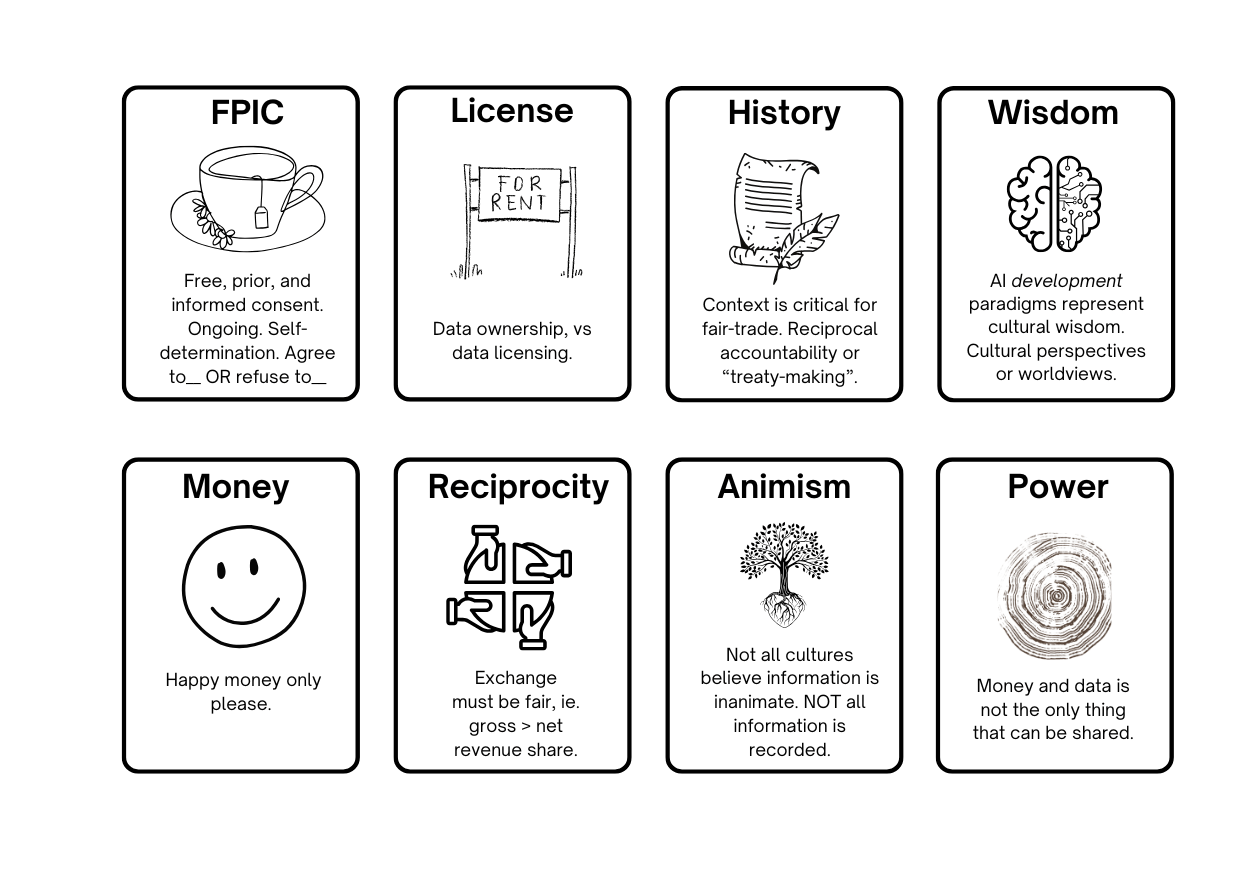
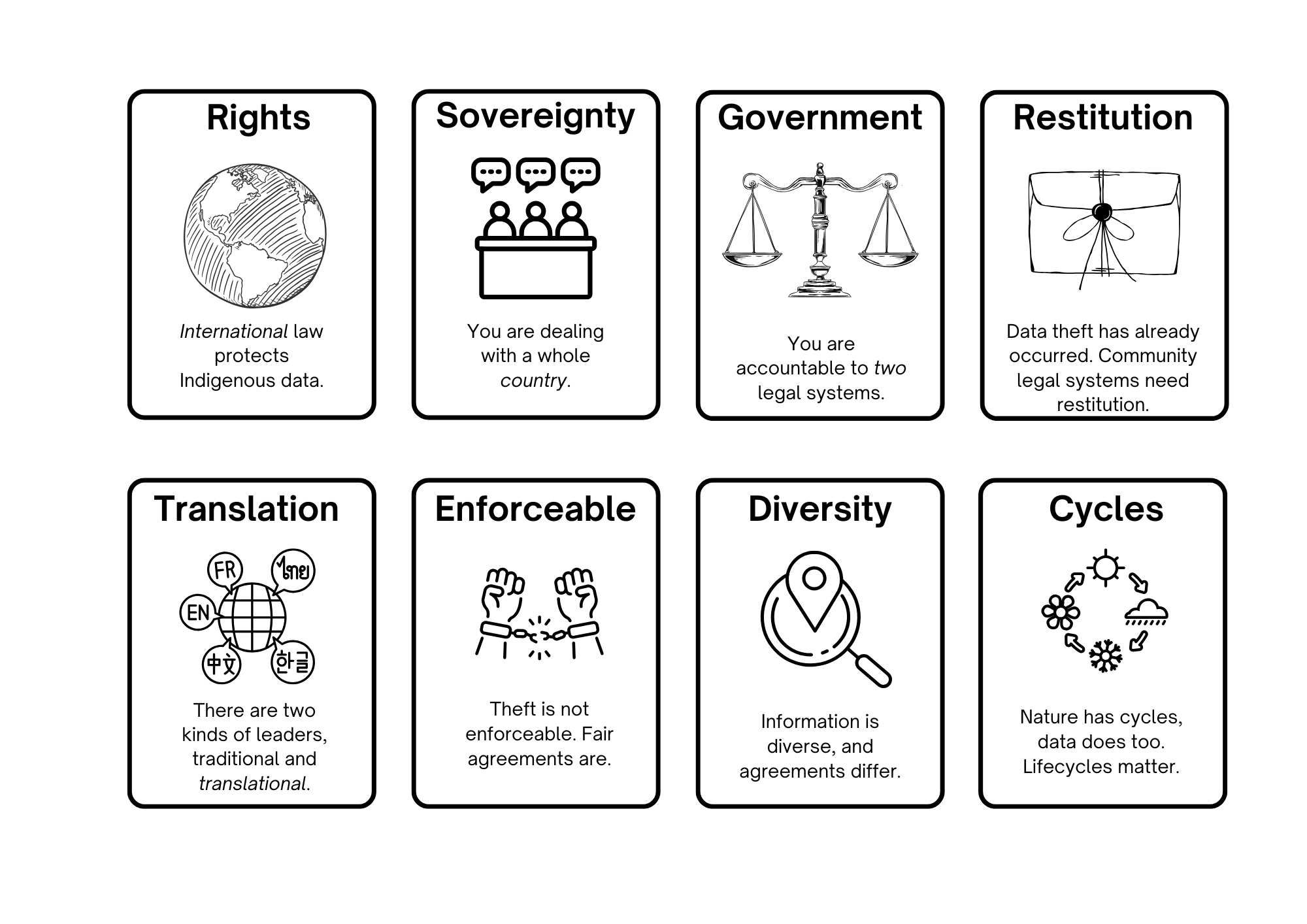
Flashcards were authored with WarīNkwī Flores from Kinray Hub. They are free to use and can be cloned and edited from Canva at this link.