
Land is for locals
When people ask your land-rights policy, and you want to sound smart…
We have a simple policy that is about accountability and responsibility of humans to Nature. We take care of where we live; we don’t claim rights to ecosystems where we can’t make that same commitment. We make friends.
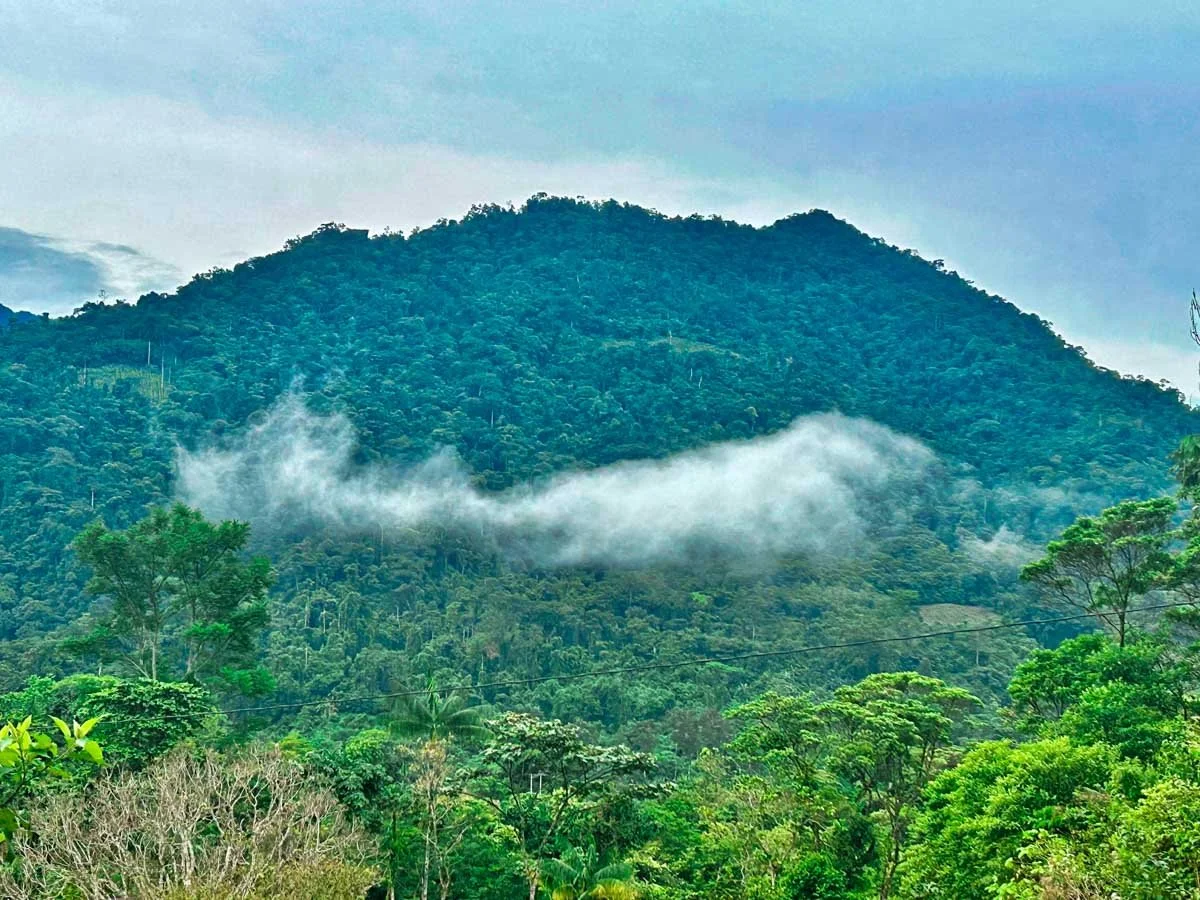
Beautiful intact land. Photo taken by locals. (Yes this is Jhony’s jungle.)
“There are deeper currencies at stake.”
A lot of climate and biodiversity initiatives are thinly-veiled real estate schemes. Let’s talk about that openly. Why it doesn’t work, and what the alternatives are.
Our policy is: Land is for locals. But we're also pragmatic about the equity of formal land titling in nations that have been living under colonialism for 200 years.
Why we still use the word colonialism
A lot of people tell us not to use the word "colonialism" as it's activating and a turnoff to people with funding and institutional wealth. (That is kind of hilarious, you have to admit 🤓).
But at the end of the day, it's not an ideological term. It's a precise, technical, structural, and economic one.
“Mass poverty is not some kind of primordial lack; it is the result of an economic system that appropriates resources from the South, pays wages below the cost of subsistence, drains profits, and seeks to militate against attempts at sovereign economic development.”
So you can't reengineer what you won't name, and this is really important for fixing planetary boundaries. Colonialism could better be understood as the extraction of resources from other people's ecosystems beyond what they could reasonably sustain. And that’s what caused climate change, so that’s what we have to fix.
Land rights today
This isn't a yesterday problem, but a today one.
Forests are still being mowed down under colonial logic. At COP30 we helped negotiate on behalf of a 30,000-hectare forest in eastern Bolivia where two European nationals — holding title from before Bolivia capped private holdings at 5 hectares — were preparing to sell to a Brazilian soy giant to clear it. The forest sits on Monkoxi customary territory, the last forested corridor of the Chiquitania on the Brazil border. Climate scientists warned that losing it would disrupt the sky rivers — the atmospheric currents that carry water across the southern Amazon — with cascading effects far beyond the property line. Bolivia ratified ILO Convention 169 in 1991. The people who live in the forest never consented to the sale. The paper says one thing; the land remembers another.
It's unfair not to be honest that "titles" are concentrated among people who live in other countries and the city, and out of sync with Indigenous, customary rights, and smallfarmer reality. These are economic structures that also don't usually cross the border to Indigenous lands, where often land can't be owned at all.
About alternate systems
We do need to point out that there are alternate systems, and that’s basically Indigenous territory in a nutshell, or variant sovereign territories that rethink the modern nation-state. Basically, the closest Western analog is Georgism. There is currently a Henry George revival — land as commons, and rent-seeking as the original sin, "you're born owing money for the privilege of occupying space”.
But we'd argue:
Georgism is a 150-year-old Western attempt to reason its way to a position Indigenous law arrived at first and never left.
UNDRIP and ILO 169 are the global legal expression of what George was groping toward.
Property law in Europe was a 500-year wrong turn that the rest of the planet is now slowly course-correcting from.
Indigenous law gives you the same outcome with less philosophical overhead — start with customary rights.
Doing this simply and easily is just starting with customary rights and land control. We have practice guides for how to apply land control in biodiversity and reforestation as well.
What we mean by land control
Land control is a term we started using for "Savimbo will go to economic bat for your customary rights with you."
It doesn't mean “might makes right”. It means that the people who live in an ecosystem are the most accountable for and to it. They are the ones who actually control what physically happens there, so they are the ones who can commit to protecting it ecologically. Land control means they are already in a position to do so, so we can start working with them to get resources for conservation, make that formal, papered, etc.
Economic land rights solutions. They won’t qualify for the carbon market without a formal title. (That’s one of the big insider facts most people don’t know, contributing to inequity in that market.) But they can qualify for Savimbo’s impact biodiversity credit, ecotourism, reforestation, and other programs that can reasonably operate within jurisdictional compliance when formal titles are never going to happen, or endlessly delayed for political reasons.
Legal land rights solutions. Sometimes they don’t have land control, but do have customary rights (historical and traditional use of the land). For instance, they’re displaced, or there is someone else logging or mining. Then it’s not an issue of how to get resources to them, it’s an enforcement and legal issue. We have the Tierra program for land buybacks and grants to cover legal action with a network of land rights lawyers we recommend.
This is really important because of this image published in Science in 2024. Most of the regions we need to protect at a planet scale are concentrated in areas that got the short end of the stick for land titles, and still have governments colluding with colonialism in one way or another. But they do have Indigenous customary rights and local land control.
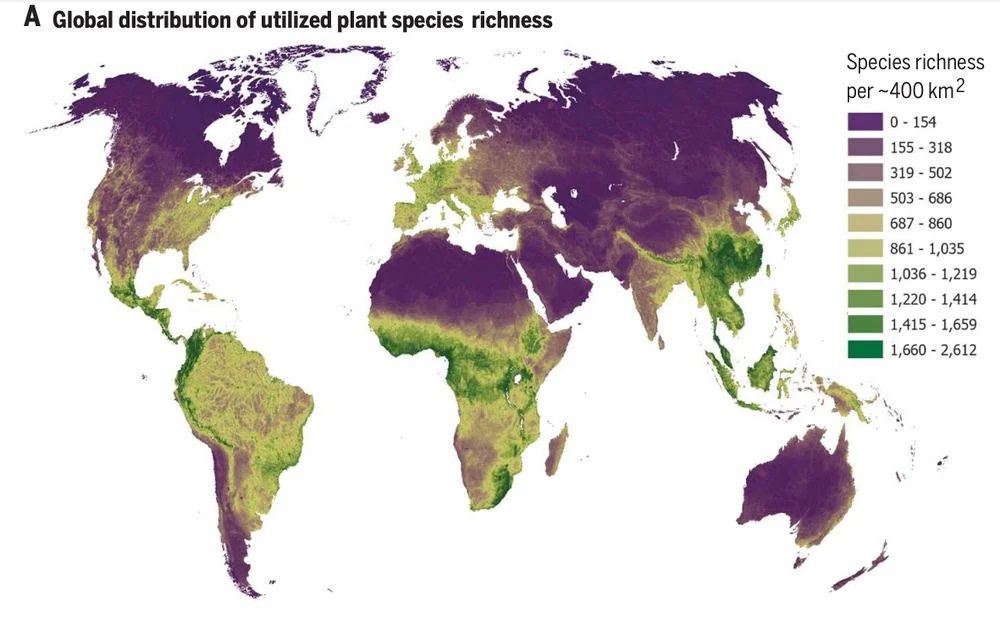
Plants used by people, mapped globally. Indigenous territories hold the densest concentrations. Pironon et al. 2024, Science.
Indigenous land rights are a global problem, and one that is finally getting the attention it deserves as a climate intervention. Land control is how we operationalise Indigenous land rights without getting stuck in the formal-title bottleneck.
We are also pacifists; we can't work in conflict, and we must resolve conflict to begin working on higher-order problems like planetary consciousness. But this comes with nuance as we consider pacifism a trade. Not an ideology.
So we work in a lot of areas like Putumayo with historical violence, inequity, and even slavery. Sometimes this is recent history. For example, in Colombia, the government is undergoing repatriation efforts called "Restitución de tierras". These are important healing processes for people and communities that have experienced war or violence, and a tree-planting or biodiversity initiative needs to work with, weave through, and respect them.
Totally gratuitous red-pilling
Okay just because you read this far into the article, you get a Savimbo special.
So people really do want to work in climate with the best of intentions, but often really have not fixed their subconscious colonialism. Yes, we definitely mean 80% of the “conscious living” crowd who are transparently buying vacation homes their children can inherit in the Global South.
Ideally, what do you do when intentions ≠ outcomes? You teach.
So we often recommend this Wired article called Land ownership makes no sense, as a colonialism red-pill. Then, and importantly, homework! It’s not enough to just nod-heads when you’re trying to get into the subconscious paradigms at play. We have to actually bring that home and into rewiring our identity.
We recommend that people read about it and think about what conflict would arise from applying it in their own home city.
They generally tend to come back and say that's practically impossible, it would never happen. And we say, fine, then don't try, and apply your systems in Indigenous territory. That's why there are borders, and Indigenous Peoples are so concerned about keeping them intact.
For the 🌎.